Sop Structure
Module focus: Foundations & Mental Models. This lesson treats SOP structure as a professional capability rather than a definition to memorise. The learner should be able to recognise the issue, choose a sensible action, explain why that action is appropriate and leave a usable record of the result.
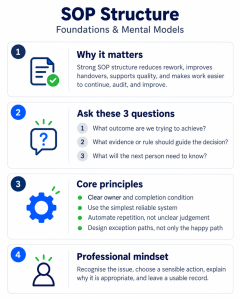
1. Why this matters
In business operations & systems, small decisions compound. Weak handling of SOP structure can create avoidable rework, customer friction, missed deadlines, data errors or trust problems. Strong handling makes the work easier to continue, easier to audit and easier to improve.
A useful professional standard is to ask three questions: What outcome are we trying to achieve? What evidence or rule should guide the decision? What will the next person need to know? These questions prevent confident guessing and keep the work anchored to an observable result.
2. Core principles
- A process needs a clear owner and completion condition.
- Use the simplest system that reliably supports the work.
- Automate stable repetition, not unclear judgement.
- Design exception paths, not only the happy path.
3. The Bekkers six-step method
- Map: Map the current state
- Define: Define owner, inputs and outputs
- Identify: Identify decisions and exceptions
- Simplify: Simplify before automating
- Add: Add controls and measures
- Review: Review adoption and improve
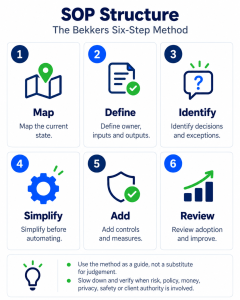
The six-step method is deliberately simple. It gives the learner a reliable default while leaving room for judgement. A checklist should support thinking, not replace it. When risk, policy, money, privacy, safety or client authority is involved, the learner should slow down and verify before acting.
4. Worked scenario
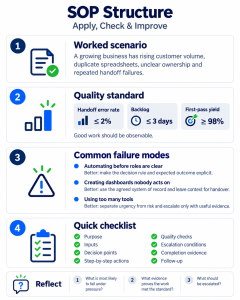
A growing business has rising customer volume, duplicate spreadsheets, unclear ownership and repeated handoff failures between internal staff and an outsourced team. The professional response is not to rush into the most obvious action. First identify what is known, what is assumed and what decision authority the role actually has. Then choose the smallest safe next step, make the uncertainty visible, and document the reasoning. This approach protects speed and quality because it prevents hidden assumptions from becoming downstream problems.
5. Quality standard
Good work in this area should be observable. Depending on the role, useful indicators include handoff error rate, backlog and first-pass yield. Metrics are not a substitute for judgement, but they reveal patterns. A single mistake may be an individual error; repeated errors in the same step often point to a process, training or system problem.
6. Common failure modes
- Failure mode: automating before roles are clear. Better: make the decision rule and expected outcome explicit.
- Failure mode: creating dashboards nobody acts on. Better: use the agreed system of record and leave enough context for handover.
- Failure mode: using too many tools. Better: separate urgency from risk and escalate only with useful evidence.
7. Practical exercise
Create a one-page operating checklist for SOP structure. It must include: purpose, inputs, decision points, step-by-step actions, quality checks, escalation conditions, completion evidence and one example of an avoidable error. Then test the checklist against a realistic task and improve any step that is vague.
8. Reflection
- Which part of this process is most likely to fail under time pressure?
- What evidence would prove that the work was completed to standard?
- What should be escalated, and what should the learner be trusted to decide independently?
Downloadable-template content
Sop Structure Quick Sheet: Objective | Inputs | Owner | Deadline | Steps | Risks | Quality Check | Escalation Rule | Completion Evidence | Follow-up.